
Secularism as a principle and practice in India is in "danger", but "forces of hatred" cannot alter the country's secular character, senior Congress leader Shashi Tharoor said during an interview on his new book 'The Battle of Belonging'. In the book, Tharoor makes a stinging critique of the Hindutva doctrine, asserting that it is a political doctrine, not a religious one.

Two people, one legally assisting the affected people because of their exclusion from the National Register of Citizens (NRC), and another whose relative has been declared a 'foreigner' by the quasi-judicial Foreigners' Tribunal (FT), talk to Rediff.com about the issues on the ground that people excluded from the NRC are facing and how it can turn into a long-drawn legal process.
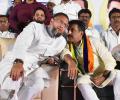
Has Owaisi's MIM become an albatross for Imtiaz Jaleel, former journalist and the party's candidate in Aurangabad?

Rahul feels collective decisions taken with his mother and sister helped the party in the December assembly elections. Hence, he wants to follow the same strategy for the Lok Sabha election, too.

He claimed the people of Delhi were facing "injustice and humiliation" since independence because the government elected by them lacked power to work for them.

In an exclusive interview to CNN-IBN, Rashtriya Swayam Sevak leader Indresh Kumar says that Bharatiya Janata Party s' prime ministerial candidate Narendra Modi is like former Prime Minister Atal Bihari Vajpayee, and compares them to Subhash Chandra Bose and Mahatma Gandhi.
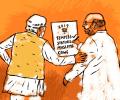
'Extravagant new promises can buy him time, but far from solving the problem, they compound the risk.' 'His main alternative is to stress not aspirations, but resentments.' 'He has already de-emphasised aspirational appeals: Nothing has been heard for over two years of the coming of achhe din,' points out James Manor.

'He totally gets the Gandhis...' 'If anything, he pays too much attention to the Gandhis.' 'I feel that in places like UP, where the Congress doesn't matter, he often spends time blasting the Gandhis.'

Performance counts more than populist slogans when you are in power, says N Sathiya Moorthy.
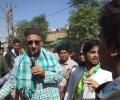
'Had Muslims been a vote bank, they wouldn't be in the condition they are now,' Asaduddin Owaisi tells Jyoti Punwani.

'Rather than an outcome of 'pro-incumbency', the exit poll results betray a completely lackadaisical approach of the Opposition parties.' 'While a new kind of politics was on display for the past five years, they were still mired in their old-style methods which will cost them the election,' predicts Utkarsh Mishra.

The Opposition can only question us if we stop them from campaigning. The opportunities are equal for all, he said.
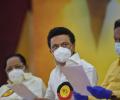
MK Stalin's ruling AIDMK rival does not thankfully face such problems as he did, but its problems could be worse if saner counsel does not prevail between now and the assembly polls, warns N Sathiya Moorthy.

Referring to COVID-19, she said her husband's administration will not stop fighting until there is an effective treatment and vaccine available to everyone.

The contemporary problem with the BJP in Tamil Nadu is that it has been trying hard to package the DMK especially as anti-god and anti-Hinduism, and seeking it to link to Periyar and M Karunanidhi, and by extension to Stalin, the latter's son and successor to the party mantle. Their hope was to consolidate the perceived 'pro-god, pro-religion votes', which they saw returning to the fold post-MGR, post-Jayalalithaa. But no such substantial vote-bank existed even in Periyar's time, says N Sathiya Moorthy.
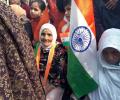
'Shaheen Bagh is no longer a mere ghetto of lower middle class Muslims.' 'Now, it is a metaphor for resistance, secularism and struggle,' notes Md. Zeeshan Ahmad.
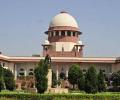
Not just candidates, but their spouses and dependents too have to reveal source of income and assets, observes the apex court.

'It is for the cricket organisers to do it and these organisers are the elected bodies. Now the reforms require that they associate cricketers also. They take care of the game that's all. I think things are moving positively. The process of reforms commenced long back has taken time. Now it is time for implementation'

Polling in Phase II of the Uttar Pradesh Assembly elections consists of 67 constituencies spread across 11 districts.

R Rajagopalan predicts that Tamil Nadu won't have single party rule for the first time in its history.
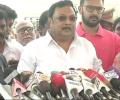
Calculated or otherwise, if Azhagiri's firing of the first salvo after Karunanidhi's death does not create some space for him to politico-electorally exploit at a later date, there may not be any space left for him at all, says N Sathiya Moorthy.

The BJP wants to win a state where it has been out of power for 15 years. The Congress wants to make its mark in a state where it has been a bit player for nearly 30 years. And the BSP wants to recapture power it lost 5 years ago.
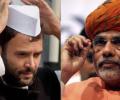
B R Ambedkar's fears about personality cults in politics and money power in elections seem to be coming true, says Nitin Desai

Without strategising together, Jayalalithaa's successor, Chief Minister Edappadi K Palaniswami, and M Karunanidhi's son-cum-successor, M K Stalin, have used tough-talking on seat-sharing with allies, to replace charisma that they purportedly lacked, during the run-up to the assembly polls scheduled for April 6, says N Sathiya Moorthy.

Rajinikanth is yet to identify a filmi platform to be able to launch his political career from the celluloid platform as only MGR had done, successfully and in the pre-IT era, says N Sathiya Moorthy.
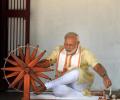
'Rather than 'consolidate' the Hindu majority votes, as the BJP-RSS combine has been known and wont to try, this time round PM Modi has himself taken the party to the next step, by seeking to create a new divide within the majority community, a la V P Singh in his time.'
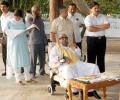
The DMK still wants to look elsewhere for excuses to its electoral debacle, says N Sathiya Moorthy.
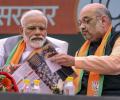
Rediff.com does a quick checklist on what the two manifestos have to say on hot-button issues of the day.

The Survey estimated that a UBI that reduces poverty to 0.5 per cent would cost 4-5 per cent of GDP, assuming that those in the top 25 per cent income bracket are not part of the loop.
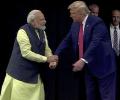
'No amount of digression can hide deflect the fact that the PM's visit was badly conceived, planned and executed,' argues Ambassador M K Bhadrakumar.

Very few old-style RSS workers-turned-leaders have survived Narendra Modi's political ambush in state politics. Harin Pathak's end closes the chapter for Modi who started his post-2002 riots journey with a new mix of profit-centric development and middle class-pleasing commerce, technology-driven communication with voters, and an unspoken Hindutva that speaks only through posturings and symbols. Rediff.com's Sheela Bhatt reveals the real reasons for the Modi-Pathak rupture.

While Narendra Modi is the talisman of his party, it is still not certain if he can claim this space among the people of India, says Seema Mustafa.

It would be a huge achievement if the new administration manages a successful transition to some sense of domestic and international normalcy in these frantic times marked by the pandemic and rise of illiberal regimes across the world, observes Shreekant Sambrani.

Shivpal refused to comment on whether the SSM will eventually part ways with the Samajwadi Party.

Shivpal Yadav said that his Mulayam will head the new party.

If the already demoralised Dravida Munnetra Kazhagam cadre, beaten worse by the shocking parliamentary poll debacle in May 2014 thought that the political set-back suffered by rival All India Anna Dravida Munnetra Kazhagam Chief Minister of Tamil Nadu, Jayalalithaa Jayaram, in the light of a Bangalore court ordering a jail-term for her in September was a boon for their leadership, it's not to be.

'The BJP has not moved on since its 2014 victory. There is nothing new to offer. There is far too much negativity about the other side and far too little about what has been achieved by its government.' 'That may have worked when the BJP was in the Opposition but if they believe that the people of India will continue to hold them to such a low standard of expectations, they are really taking the voter for granted or misreading his pulse.'

Dharmendra Kumar Singh explains the four major factors that contributed to Modi's win in the 2014 elections.

'Gujarat is number one in public relations and marketing. Gujarat's PR is strong, it washes like a strong washing soap... The third phase is ours. It is our family and household elections, let him come there... Banaras and UP have taken on the challenge.' Uttar Pradesh Chief Minister Akhilesh Yadav tells Rediff.com contributor Neeta Kolhatkar how he plans to keep Narendra Modi at bay.

'If Modi were to be elected, he would be part of a coalition government, and within that he would have to take this minority into account. Muslims cannot relate to the idea of Hindu nationalism. Although it is presented as a pan-Indian idea, it appears to them to be exclusive.'
